
AI Visibility Audit: Methodology, 598 Rules, and What Your Brand Needs to Fix
See how AI-ready your site is.
Five analyzers across AIO, AEO, and GEO — AI crawler access, schema.org, llms.txt, MCP discovery, on-page citability. Scores plus a prioritized fix list, saved to your free RankCaster workspace.
Run Free AI-Readiness AuditAI Visibility Audit: Methodology, 598 Rules, and What Your Brand Needs to Fix
Traditional SEO audits were built for a world in which search engines crawled websites, indexed pages, and ranked results. That world still exists. But it is no longer the whole picture.
Today, people ask ChatGPT to compare products, use Claude to research services, turn to Perplexity for sources, and discover information through Gemini, DeepSeek, and Google's AI Overviews. Instead of clicking through ten blue links, they may receive a synthesized answer that recommends three brands and ignores the rest.
For businesses, this creates a new visibility problem. Your website can perform well in traditional search and still be difficult for AI systems to discover, interpret, or cite.
A conventional SEO audit does not necessarily examine these issues in sufficient depth. AI search visibility requires additional checks: whether AI crawlers can access your content, whether machines can identify your business and its offerings, and whether your pages contain information that generative systems can confidently reuse.
That's the purpose of an AI visibility audit.
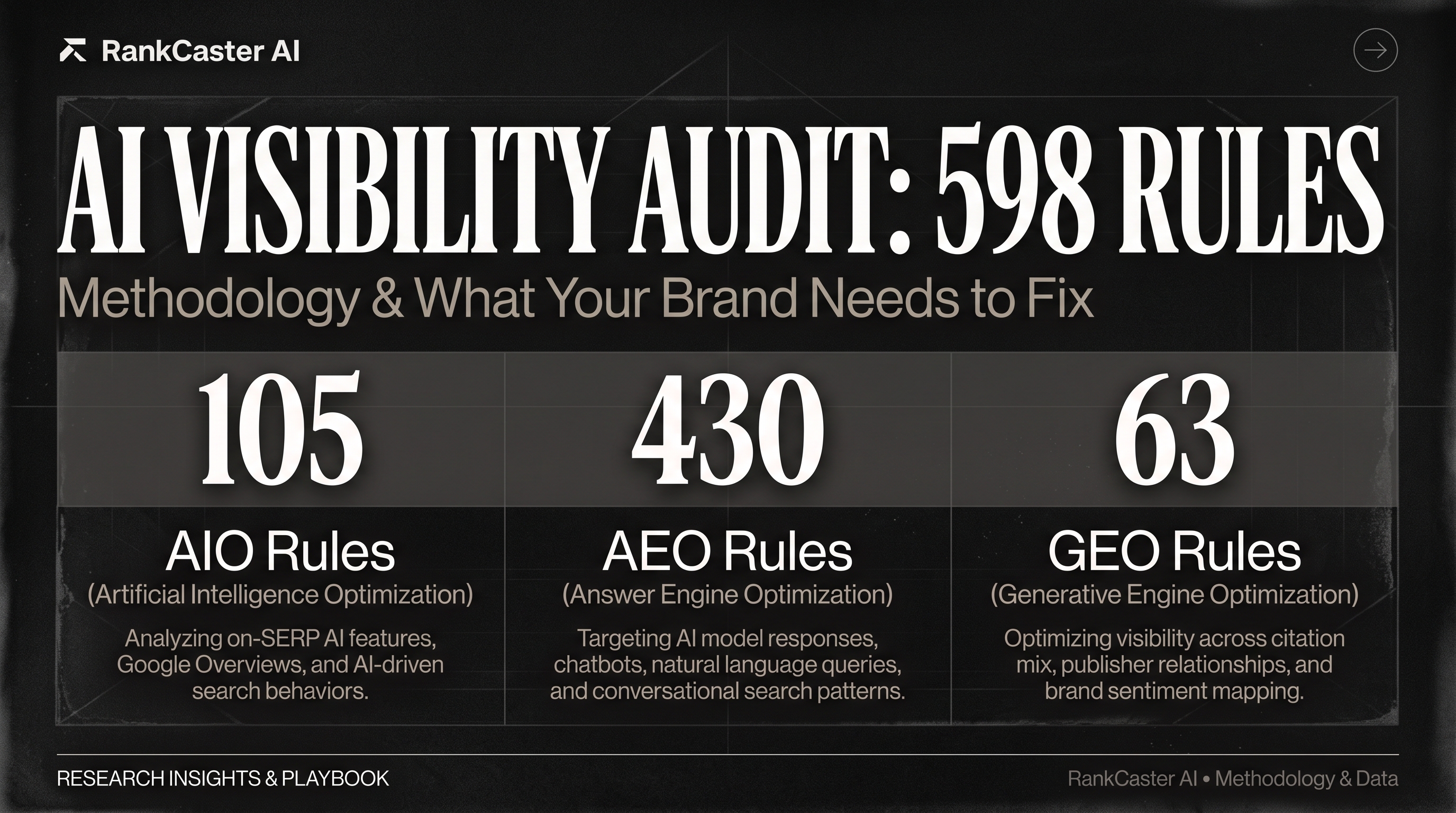
At RankCaster AI, we organize this work into three layers: AI Optimization (AIO), Answer Engine Optimization (AEO), and Generative Engine Optimization (GEO). Together, they form a technical and content-oriented framework built around 598 audit rules:
- 105 AIO rules covering AI crawler access and related technical signals.
- 430 AEO rules covering structured data and machine-readable entities.
- 63 GEO rules covering on-page structure, information quality, and citability.
Here's what each layer examines, why it matters, and how to turn the findings into an actionable AI search optimization plan.
1. What Is an AI Visibility Audit?
An AI visibility audit evaluates whether a website is technically accessible to relevant AI systems, describes its entities and offerings in a machine-readable way, and presents information that generative systems can understand and potentially cite.
It complements traditional SEO rather than replacing it.
| Audit layer | Core question | What it examines | Why it matters |
|---|---|---|---|
| AIO, AI Optimization | Can relevant AI crawlers access the website? | Crawler directives, robots.txt, AI-oriented files, access restrictions, and related technical signals |
Inaccessible content cannot be retrieved by a crawler that is blocked from reaching it |
| AEO, Answer Engine Optimization | Can machines identify the entities, facts, and relationships on the website? | Schema.org types, required properties, entity identifiers, and knowledge graph connections | Clear structured data can reduce ambiguity about what a business is and what it offers |
| GEO, Generative Engine Optimization | Is the content structured and informative enough to be useful as a source in AI-generated answers? | Heading hierarchy, content chunkability, trust signals, references, and content quality | Self-contained, well-supported information is easier to interpret and potentially reuse |
These layers address different problems. A website may allow crawlers to access its pages but describe its products poorly in structured data. Another may have valid Schema.org markup but publish content that is vague, difficult to extract, or unsupported by authoritative references.
An AI visibility audit helps distinguish these issues instead of treating them as one generic optimization problem.
It also establishes an important boundary: passing technical checks does not guarantee that ChatGPT, Claude, or another AI system will mention your brand. Visibility depends on many factors beyond your website, including the user's question, the system's retrieval process, the information available elsewhere, and the model's response.
The goal is to identify and address barriers that the website owner can actually influence.
2. Three Layers of AI Search Visibility
The AIO, AEO, and GEO framework divides AI readiness into three complementary areas.
AIO: AI Optimization
AIO focuses on technical accessibility. It examines whether relevant crawlers can reach the website and whether technical restrictions interfere with retrieving its content.
AEO: Answer Engine Optimization
AEO focuses on structured information. It examines whether machines can identify important entities, interpret their properties, and connect them to other entities without unnecessary ambiguity.
GEO: Generative Engine Optimization
GEO focuses on the information itself: how clearly a page communicates its facts, how well the content is organized, and whether individual passages can stand on their own as useful sources.
RankCaster AI's audit framework contains 598 rules distributed across these layers. The allocation reflects their different scopes: AEO has the largest rule set because structured-data requirements vary considerably across entities and industries.
Let's examine each layer in detail.
3. AIO: AI Crawler Access, 105 Rules
Before optimizing content for AI discovery, establish whether the relevant systems can access it.
A website may contain excellent research, detailed product descriptions, and comprehensive documentation. But if a crawler encounters a blocking directive, an access restriction, or a rendering problem, those resources may not be available through that crawler's retrieval path.
This makes AIO the logical starting point for an AI search optimization audit.
AI crawlers are not all the same
A common mistake is to assume that allowing Googlebot automatically resolves access for every AI-related system.
It does not.
Websites can define different crawling policies for different user agents. Depending on the service and its architecture, relevant crawler identities may include:
GPTBotClaudeBotPerplexityBotGoogle-ExtendedCCBotBytespider
These identities do not all serve the same purpose. In particular, Google documents Google-Extended as a control token used to manage certain uses of content fetched by Google's existing crawlers. It is not a separate HTTP crawler, and its controls do not determine whether a site appears in Google Search.
The practical lesson is to examine each relevant directive in context rather than applying one blanket rule to every AI service.
What the AIO layer checks
The 105-rule AIO layer examines technical conditions that may interfere with AI accessibility.
1. robots.txt directives
A global Disallow: / can prevent compliant crawlers covered by the directive from accessing the entire site. More selective rules can also block valuable documentation, product pages, or other important resources.
The correct policy depends on the website and the crawler. The objective is not to allow every bot indiscriminately; it is to make deliberate decisions about which systems may access which resources.
2. llms.txt and llms-full.txt
These files are intended to provide AI-oriented guidance or organized information about a website.
Their presence alone is not proof of AI readiness. Their structure, content, availability, and usefulness also matter. A file that exists but offers little meaningful information may provide limited practical value.
They should also be treated as complementary resources, not as a universal substitute for crawlable pages or a guarantee that AI systems will use the information.
3. JavaScript-dependent content
Some websites rely heavily on client-side JavaScript to display essential information. If a retrieval system cannot access or correctly render that content, the resulting view of the page may be incomplete.
A JavaScript-heavy website is not automatically invisible to AI. The relevant question is whether the systems that need to access it can retrieve the information reliably.
4. Response and content-delivery problems
Incorrect response headers, unexpected content types, access challenges, and differences between what a site serves to different clients can interfere with retrieval.
Cloaking deserves particular attention. If the content presented to crawlers differs materially from what users receive, the discrepancy can undermine trust and create technical or policy risks.
Why AIO comes first
Suppose a company has published excellent documentation explaining its product, pricing, and use cases. Its structured data is valid, and its content is well organized.
But the relevant crawler is blocked from accessing those pages.
Improving the schema or rewriting paragraphs will not remove that access restriction.
That's why the audit prioritizes critical AIO findings. Technical access is a prerequisite for retrieval through the affected crawler, even though it cannot guarantee that a system will retrieve, index, or cite a page.
4. AEO: Structured Data for Answer Engines, 430 Rules
AEO is the largest layer of the RankCaster AI audit framework, with 430 rules.
Why so many?
Because structured data is not one universal checklist. A person, hotel, restaurant, software company, university course, and apartment complex have different properties and relationships. A meaningful audit must account for those differences.
Valid Schema.org syntax is only the beginning
A page can contain syntactically valid Schema.org markup and still communicate incomplete or ambiguous information.
For example, a business may declare an Organization entity but omit properties needed to describe its services clearly. A hotel may have structured data that identifies it as a hotel without providing important property details. A course page may use the correct general type while leaving out relevant information about its provider or educational offering.
An effective audit therefore needs to distinguish between several questions:
- Is the structured data syntactically valid?
- Is the selected type appropriate for the entity?
- Are relevant required or recommended properties present?
- Are the values meaningful and consistent with the visible content?
- Can the entity be connected to other descriptions of the same entity?
These questions go beyond checking whether a JSON-LD block exists.
Why @id matters
Structured data becomes more useful when entities have stable identifiers.
In JSON-LD, @id can identify an entity through a URI. This allows multiple descriptions to refer to the same entity instead of creating disconnected representations of a business, person, product, or organization.
Consider a company that publishes an organization description on its homepage and separate descriptions of its products on product pages.
A consistent entity model can connect these descriptions. Rather than treating each occurrence of the company name as an unrelated string, a consumer of the data can follow references to the same identified entity.
This is one reason why structured data should be considered part of a website's knowledge architecture, not merely a collection of markup snippets.
Connecting entities to Wikidata
External identifiers can provide another way to disambiguate entities.
Where appropriate, a sameAs property can connect an entity to an authoritative external profile, including a relevant Wikidata entity.
For example, an organization with a genuine Wikidata entry may use the corresponding identifier to connect its own structured description with that external entity.
The important qualification is where appropriate. A sameAs relationship should indicate identity, not a loose topical association. Pointing to an unrelated entity simply to add an external identifier creates confusion rather than resolving it.
Not every business needs a Wikidata entry, and adding sameAs links does not guarantee better AI visibility. The value lies in accurate entity identification and consistent relationships.
AI-oriented Schema.org types
The AEO layer includes types and properties that can be especially relevant to information retrieval, knowledge representation, and specific kinds of content.
Examples include:
Dataset, describes a dataset and its associated metadata.DefinedTerm, represents a defined term, such as an entry in a controlled vocabulary.ClaimReview, describes a fact-checking review of a claim.FAQPage, represents a page containing frequently asked questions and their answers, subject to the applicable search-platform policies.Person.alumniOf, expresses an educational relationship between a person and an educational organization.
These types serve different purposes. They should be used when the underlying content genuinely fits the type, not added indiscriminately because a website is trying to optimize for AI.
The audit examines whether the relevant structured-data patterns are present and appropriately formed for the content being described.
Industry-specific checks create a long tail
Generic schema validation cannot adequately cover every business model.
Consider the differences among the following entities:
- A hotel may need property-specific information.
- A restaurant may have menus, opening hours, and location details.
- An apartment complex has different attributes from an individual apartment listing.
- A ski resort has information relevant to its facilities and seasonal operation.
- A job posting needs employment-related information.
- A movie has creative-work metadata.
- A course has educational information and may identify its provider.
The applicable checks vary with the entity type and its properties. This creates a long tail of industry-specific requirements.
That is the reason AEO accounts for 430 rules in the RankCaster AI methodology: the layer must cover much more than a few generic organization and product schemas.
What AEO can-and cannot-do
Structured data can make a website's information more explicit and machine-readable. It can reduce ambiguity about the entities and relationships a page describes.
It cannot force an AI system to select a brand, establish that every statement on a website is true, or substitute for useful content and a technically accessible site.
AEO is about making the information easier to interpret, not manipulating a model into recommending a particular business.
5. GEO: Making Content Citable, 63 Rules
The third layer examines the content presented to users and machines.
Generative Engine Optimization asks a different question from traditional keyword optimization: does a page provide clear, useful, sufficiently complete information that an AI system could retrieve and reuse when answering a relevant question?
The audit's GEO layer contains 63 rules covering content structure, information quality, and related signals.
Why citation is a separate problem
Imagine two pages that discuss the same subject.
The first is full of broad marketing claims:
We deliver innovative, world-class solutions that help businesses transform their digital future.
The second explains what the product does, who it serves, how it works, and which limitations or conditions apply.
The second page provides more concrete information that can be evaluated against a specific user question.
That does not guarantee a citation. An AI system may rely on another source, use a different retrieval process, or generate an answer that does not require either page. But the example illustrates why clear, specific information is more useful than unsupported promotional language.
Chunkability: Can a passage stand on its own?
AI systems may retrieve and process parts of a page rather than treating every document as one indivisible block.
This makes chunkability an important content-design concept.
A useful content chunk should communicate a coherent idea with enough context to remain understandable when separated from the surrounding text.
Consider this example:
It offers several advantages. These features make it better than the alternatives.
Without the preceding paragraphs, the passage tells the reader almost nothing. What does "it" refer to? Which advantages? Which alternatives?
Now consider:
AEO audits evaluate whether a website's structured data identifies its entities, includes relevant properties, and connects related descriptions through consistent identifiers.
This sentence identifies its subject, explains the activity, and states the criteria. It can be understood independently of the rest of the article.
The second example is more self-contained and easier to reuse as a factual explanation.
The role of subject-predicate-object relationships
A useful way to think about a self-contained factual statement is through the subject-predicate-object, or SPO, pattern.
For example:
- Subject: RankCaster AI's audit
- Predicate: evaluates
- Object: technical and content signals related to AI readiness
This structure helps clarify who or what a statement concerns, what relationship or action is being expressed, and what the statement is about.
SPO is a useful conceptual model for making facts explicit. It is not a universal scoring formula for citation likelihood, nor does every good passage need to follow a rigid grammatical template.
The broader principle is to reduce ambiguity and give each passage enough context to communicate its main point.
Heading hierarchy: H1 → H2 → H3
Headings create a navigable structure for readers and provide organizational context for systems processing a page.
A sensible hierarchy moves from the primary topic to its major sections and then to supporting subsections:
- H1: The main topic of the page.
- H2: A major section addressing one aspect of that topic.
- H3: A subsection that explains a more specific point within the section.
Problems arise when headings are selected for appearance rather than meaning, when sections jump unpredictably between topics, or when headings promise information that the following content does not provide.
A logical hierarchy makes it easier to understand how individual statements relate to the page's overall subject.
Chunkability thresholds and content completeness
The GEO layer evaluates content structure and chunkability against defined criteria.
The purpose is not to make every paragraph the same length. A short definition may need only two sentences; a technical explanation may require several paragraphs, examples, and qualifications.
Instead, the question is whether a passage communicates its intended point clearly and completely enough for its purpose.
A good explanation usually provides the necessary context, states the relevant fact, and avoids making the reader reconstruct the meaning from distant sections.
E-E-A-T-related signals and outbound authority
Experience, expertise, authoritativeness, and trustworthiness-commonly discussed as E-E-A-T-provide a useful framework for thinking about content credibility.
Relevant signals may include:
- Clear authorship and appropriate attribution.
- Specific explanations supported by evidence.
- References to authoritative sources where they are relevant.
- Transparent descriptions of methods, limitations, and claims.
- Consistency between the content, its author, and the organization publishing it.
Outbound references can help readers verify factual claims and explore the underlying evidence. Their usefulness depends on the quality and relevance of the cited sources, not simply on the number of external links.
No single E-E-A-T signal guarantees that a generative engine will cite a page. GEO should focus on making information genuinely useful and verifiable rather than manufacturing superficial indicators of authority.
LLM-as-judge: Evaluating content quality
The GEO methodology also uses LLM-as-judge evaluation across four dimensions:
| Dimension | What it asks |
|---|---|
| Helpfulness | Does the content meaningfully address the user's question or need? |
| Clarity | Can the intended meaning be understood without unnecessary ambiguity? |
| Completeness | Does the explanation include the essential information needed for its purpose? |
| Depth | Does the content provide meaningful detail rather than stopping at generic statements? |
These dimensions provide a structured way to assess content quality.
An LLM-based evaluation is still an evaluation method, not an objective guarantee of future citations. Its results need to be interpreted in context, especially when the topic is subjective or requires specialist expertise.
The aim is to identify content that deserves improvement: vague explanations, missing context, unsupported claims, shallow coverage, and passages that are difficult to interpret independently.
6. How the AI Visibility Audit Works
An audit is useful only if it turns technical observations into decisions a website owner can act on.
The RankCaster AI audit follows the website's sitemap as the starting point for examining the site. The time required for a full audit depends on the size of the website and the amount of content that needs to be checked; larger sites can take several minutes.
The resulting report organizes findings so that teams can move from diagnosis to remediation.
From findings to fixes
Each finding is evaluated and presented with information intended to help the team understand its importance and next steps.
The report includes:
- Finding: The issue identified by the audit.
- Severity: Critical, high, medium, or low.
- Score impact: The finding's impact on the audit score.
- Recommended fix: A specific direction for remediation.
- Relevant technical snippet: Where applicable, a nearby HTML, Schema.org, or
robots.txtexample to help explain the change.
The exact fix depends on the problem. A crawler-access issue may require a change to a robots directive. A structured-data issue may require a missing property or an incorrect entity relationship to be corrected. A content issue may need a clearer explanation, better section structure, or stronger supporting evidence.
The objective is to connect the diagnosis to an implementation task instead of leaving the team with a score and a generic recommendation to improve AI readiness.
Prioritize by dependency, not by convenience
Not every finding deserves immediate attention.
A practical remediation sequence begins with critical AIO problems. If a relevant crawler is blocked from accessing important pages, improving those pages' schema and content may not solve the underlying access problem.
Once critical access issues have been addressed, teams can work through critical AEO and GEO findings, followed by high-, medium-, and low-severity items.
A useful prioritization framework looks like this:
| Priority | Typical focus | Next step |
|---|---|---|
| 1. Critical AIO | Blocking directives or other major access barriers | Verify the intended crawler policy and correct unintended restrictions |
| 2. Critical AEO | Material problems with entity identification or structured data | Correct the schema types, properties, and entity relationships |
| 3. Critical GEO | Major clarity, structure, or information-quality problems | Rewrite or reorganize the affected content |
| 4. High severity | Significant remaining technical or content gaps | Assign fixes based on business importance and implementation effort |
| 5. Medium and low severity | Less consequential gaps and refinements | Schedule improvements into the ongoing optimization process |
Severity should guide attention, not replace judgment. A technically significant issue on an irrelevant page may deserve less immediate attention than a smaller issue on a core commercial page.
The best remediation plan combines the audit's findings with the site's business priorities.
7. What Comes After the Audit?
An audit identifies problems. It does not, by itself, build sustained AI visibility.
The next step is to create a repeatable process: measure where the brand appears, understand which opportunities matter, improve the website and its content, and observe what changes.
RankCaster AI connects the audit with tools designed to support that process.
Monitor brand mentions across six AI engines
Technical readiness and actual brand visibility are different things.
Monitoring helps teams examine whether their brand appears in AI-generated answers to relevant prompts and how competitors appear in the same context.
RankCaster AI's monitoring covers six active AI engines. Teams can track their own prompts and compare brand presence with competitors to understand where they appear, where they are missing, and which topics warrant further investigation.
This provides a measurement layer alongside the technical audit. It helps answer questions that a site inspection alone cannot resolve: whether the brand is mentioned, which competitors appear in relevant answers, and how those observations change over time.
Monitoring does not guarantee that visibility will improve. It supplies evidence that can inform the next optimization decision.
Measure AI traffic from 14+ sources
Being mentioned in an AI answer is not the same as receiving a website visit.
RankCaster AI's AI-traffic pixel is designed to detect traffic from 14 or more AI-related sources, including Microsoft Copilot, Grok, Mistral, You.com, Phind, Meta AI, Poe, and Hugging Face.
These sources complement the six engines covered by the monitoring module. The two numbers describe different capabilities: monitoring measures brand presence in AI answers, while traffic detection identifies visits attributed to AI-related sources.
This distinction matters because teams need to understand both visibility and the traffic that reaches their websites.
Traffic attribution can help answer practical questions:
- Which AI-related sources are sending visitors?
- Which landing pages receive those visits?
- Is AI-referred traffic changing over time?
- Do those visitors take meaningful actions on the site?
The pixel provides a measurement layer; it should not be interpreted as proof that every detected visit resulted from a specific brand mention or AI answer.
Turn content gaps into published material
When monitoring and audit findings reveal missing information, the next challenge is execution.
RankCaster AI's Content Manager supports a workflow that connects content creation with identified opportunities. Its publishing options include WordPress, Wix, a native blog, and automated social publishing.
The workflow also includes quality gates designed to help keep content useful and relevant:
- Length checks to identify drafts that fail configured content requirements.
- Anti-AI-slop checks to flag generic, repetitive, or low-value writing.
- Prompt-relevance embeddings to assess how closely a draft relates to its intended prompt or topic.
- Fact-checking against top-APR sources to help verify claims against relevant sources associated with strong Answer Presence Rate results.
These checks are intended to improve the quality and relevance of drafts before publication. They do not eliminate the need for human review, particularly for factual claims, sensitive subjects, or content requiring specialist knowledge.
The goal is to connect an identified opportunity to a useful piece of content that can be reviewed, published, and measured.
Find the communities AI already cites
AI visibility is not exclusively a website problem. Relevant information may also exist in industry publications, professional communities, directories, and other external sources.
RankCaster AI's Social Media Manager helps identify communities and topics that AI systems already cite. This can inform decisions about where a brand should participate and which subjects deserve attention.
The important distinction is between meaningful participation and indiscriminate promotion. Publishing useful, relevant information in the right places can contribute to a broader information footprint. Posting repetitive promotional material everywhere is not a substitute for credibility.
Make business information accessible through MCP
The Model Context Protocol (MCP) provides a standardized way for compatible AI applications to interact with tools and data.
RankCaster AI's MCP-as-a-Service offering supports a discoverable MCP endpoint at /.well-known/mcp and a register_lead integration with HubSpot and Brevo.
For businesses, this creates a potential connection between AI-assisted interactions and existing lead-management workflows.
As with other technical integrations, implementation details matter. A discoverable endpoint alone does not guarantee that an AI application will use it. Integrations also need appropriate permissions, clear tool definitions, and reliable handling of data and actions.
Turn verified progress into a public certificate
Agencies need ways to communicate their work to clients.
RankCaster AI also supports a public AI-visibility certificate that can be used to showcase progress in a portfolio or client-facing presentation.
For a GEO agency, this can help make an otherwise abstract service easier to explain. Instead of presenting only a list of technical tasks, the agency can provide a public artifact associated with the brand's AI-visibility work.
A certificate should complement the underlying measurements rather than replace them. The meaningful evidence remains the methodology, the results, and the changes observed over time.
From diagnosis to an operating process
Together, these capabilities support a continuous workflow:
- Audit the website to identify technical and content-related barriers.
- Monitor relevant prompts and competitor presence across AI engines.
- Measure AI-related website traffic.
- Create and publish useful content that addresses identified gaps.
- Improve external discoverability by engaging with relevant communities and sources.
- Connect AI interactions to appropriate business workflows.
- Review the evidence and repeat the process.
The audit provides the starting point. Ongoing measurement and implementation turn it into a broader AI visibility strategy.
8. Frequently Asked Questions
How is an AI visibility audit different from a traditional SEO audit?
A traditional SEO audit generally focuses on search-engine crawling, indexing, technical SEO, and organic-search performance. An AI visibility audit adds checks for AI crawler access, structured data and entity relationships, and content characteristics relevant to AI-driven discovery and citation.
The two approaches overlap, but neither automatically replaces the other. Websites still need a sound SEO foundation while addressing the additional requirements of AI search.
How long does an AI visibility audit take?
The time required depends on the website's size and the amount of content examined. A full audit that follows the sitemap can take several minutes, with larger websites potentially requiring more time.
The report organizes findings by severity and provides remediation guidance so that teams can prioritize the work that matters most.
Which AI engines does RankCaster AI cover?
RankCaster AI's monitoring module covers six active AI engines, including systems such as ChatGPT, Claude, Perplexity, Gemini, DeepSeek, and Google AI Overviews.
Its AI-traffic pixel detects visits from 14 or more AI-related sources, including Microsoft Copilot, Grok, Mistral, You.com, Phind, Meta AI, Poe, and Hugging Face.
These are separate capabilities: the monitoring module tracks brand presence in AI answers, while the pixel detects AI-related website traffic.
What is the difference between GEO and AEO?
AEO, or Answer Engine Optimization, focuses on making information machine-readable through structured data, clear entity identification, and explicit relationships.
GEO, or Generative Engine Optimization, focuses on making content useful and interpretable for generative systems through clear structure, self-contained explanations, relevant evidence, and information quality.
In practice, they complement each other. Structured data helps describe what a page and its entities represent; well-organized content explains the information itself.
Is the RankCaster AI audit free, and do I need an account?
RankCaster AI provides a free AI-readiness audit through its public audit page. Follow the instructions on the page to submit your website and receive the report.
You can start here: Run the free AI visibility audit.
How often should I repeat an AI visibility audit?
Repeat an audit after substantial website changes, including changes to robots directives, structured data, templates, content architecture, or publishing infrastructure. Periodic checks can also help identify regressions.
The appropriate frequency depends on how often the site changes and how critical AI-driven discovery is to the business. Monitoring brand mentions and traffic between audits can help identify changes that warrant an earlier technical review.
Can an agency automate AI visibility audits for 50 or more clients?
Agencies managing many clients need a repeatable workflow for discovering issues, prioritizing fixes, and communicating results.
Automation can reduce the manual effort involved in recurring checks and reporting. However, the practical suitability of any workflow depends on its supported audit scope, account structure, access requirements, and reporting capabilities.
For an agency managing 50 or more websites, the key questions are whether the process can be repeated consistently, whether findings can be assigned and tracked, and whether the results can be translated into client-ready recommendations.
9. Run Your Free AI Visibility Audit
AI search visibility is not one technical setting or one markup format. It is the result of several connected conditions: relevant crawlers must be able to access the content, machines need a clear representation of the entities and relationships on the site, and the content must communicate useful information.
RankCaster AI's 598-rule framework organizes these concerns into three layers:
- AIO: 105 rules for AI crawler access.
- AEO: 430 rules for structured data and entity relationships.
- GEO: 63 rules for content structure and citability.
The findings provide a starting point for deciding what to fix first. From there, monitoring, traffic measurement, content workflows, and ongoing validation can help turn an audit into a repeatable optimization process.
You don't need to guess where your website may be falling short.
Run your free AI visibility audit and start identifying the technical and content improvements that can support your AI search optimization strategy.
Get the AV-Index in your inbox.
New AI-visibility research, monthly. APR snapshots from real agencies. Pages and prompts that moved. No fluff, no daily noise.
~1 email per month · unsubscribe in one click · privacy