
Step-by-step guide · 2026
How can you improve your brand's visibility in AI?
A step-by-step playbook to improve brand visibility in AI search — ChatGPT, Claude, Perplexity, Google AI Overviews, Gemini and DeepSeek — in nine sequential steps. Each one: why, what to do, how to tell it's done, a worked example and the visibility tools inside RankCaster that compress it from weeks to minutes. By the end you move the brand from "invisible to ChatGPT" into the 50–60% APR band — the owned + external tier.
Before you start · 3 minutes
A three-minute vocabulary
Two metrics you'll be naming on every step, and one stack that drives the actual programme of work.
45%sample
How often AI names you
For a given prompt, the share of AI answers that mention the brand (any occurrence of the name — neutral, recommending, comparative). It's a visibility diagnostic, not a sentiment metric: recommendation vs neutral tone goes to the brand tracker separately.
12%sample
How often AI cites you as a source
The share of AI answers where your domain lands in the source list. In parallel we track citation share across all domains (competitors, G2, Reddit) — to see who AI actually treats as a source instead of you.
rule
High APR + low BSCR = AI knows you, but is learning from someone else. The day they rewrite that piece, your APR drops. This is the central diagnostic signal of the whole programme.
Work stack · 598 Auditor rules
AIO → AEO → GEO · three distinct jobs
Fix from the bottom up. A beautiful schema graph on a page the crawler can't fetch scores zero.
Write so your text can be quoted
AI doesn't like assembling an answer from pieces across different pages — it picks the one where the answer is already written as a single block. In practice: every paragraph on a key page answers one specific question on its own, without pointing to the neighbours. The first sentence is the direct answer; the rest is detail, numbers, examples. Length — 40–80 words: shorter leaves AI without context, longer and it picks the competitor.
Example rules: no filler phrases ("in today's world", "cutting-edge solutions"); every H2 is a question your buyer asks; the paragraph under an H2 opens with the direct answer in the first sentence; every number and fact is specific — no "many" or "recently"; no pronouns without a clear antecedent ("this", "that approach").
Tell AI what kind of object it's looking at
To AI, a page isn't just a wall of text — it's a specific object: a product with a price, a company with an office, an article with an expert author. For AI to see that, the human text on the page is accompanied by machine-readable markup (Schema.org) — invisible labels that explain to each block what kind of entity it is. Without them, AI often confuses your brand with another business of a similar name, attributes your article to someone else's author, or picks the price for your product from a competitor's page.
Example rules: the company page carries an Organization block with name, address and logo; the product page a Product block with price, currency and availability; the article page an Article block with the author's name, role, employer and publication date; the sameAs field lists every external profile for the entity (LinkedIn, Crunchbase, Wikipedia); every block has a stable @id that doesn't change between releases; the markup validates against the Schema.org spec (checked automatically).
Let AI onto your site
AI search crawls sites with its own bots, separate from Google: GPTBot for ChatGPT, ClaudeBot for Claude, PerplexityBot for Perplexity, Google-Extended for Gemini, and a few more. If your site accidentally blocks them or serves them an empty page (for example, because the content appears only after JavaScript runs — and the bot doesn't run JS) — everything else is wasted work. Google will keep seeing the site fine, and you won't notice a thing.
Example rules: robots.txt explicitly allows all 6 major AI bots on key pages; curl with User-Agent: GPTBot/1.0 returns 200 OK and real page text, not a redirect; the initial HTML (before JavaScript runs) contains more than 500 words of meaningful content; the bot receives the same HTML a human does (not a "stripped-down server version"); the site root contains an llms.txt — a short summary of the company with links to the main pages.
The 105 / 430 / 63 split is RankCaster Auditor's own methodology, not consensus industry taxonomy: AEO and GEO appear in the literature as umbrella terms, AIO is our label for the crawlability layer. Full rule-set, sources (Schema.org, Google Rich Results, OpenAI / Anthropic docs) and the rationale behind the layer boundaries are in the full methodology.
The nine steps · in order
01 · Step 1 of 9
Who you sell to
Outcome — A buyer portrait: which company, and who inside it. The prompts for Step 2 come from here.
Why this step
Inside one company, three people ask about the same product in three different ways — and ChatGPT answers each one with a different list of brands. Write prompts "for the average customer" and you end up with prompts no-one actually types.
What to do
- 1.The product in 3–5 lines. What you do, what you charge for, how you differ from the competitors AI will name next to you.
- 2.The buying company. Industry, headcount, what they already run, when they're typically ready to buy.
- 3.2–4 people inside that company who drive the deal. Usually: the one who pays; the one who hurts; the one who vets security; the one who uses it daily.
- 4.2–3 prompts per person. A full question, chat-style. Not "CLM Salesforce" but "recommend a CLM that integrates with Salesforce for a 300-lawyer team".
Acceptance check
The page holds a company, 2–4 people, and 2+ prompts per person. If the prompts don't come out — fill in the person's portrait more.
Example
Example · contract-management software for legal teams
Company: SaaS of 200–1000 people. Running Salesforce and Slack. Signing 300+ contracts a year. Decision takes 2–3 months.
Three people drive the deal:
| Who | What they do | What they ask AI |
|---|---|---|
| General Counsel | Brings the problem, drags the product in | "Why are my lawyers drowning in contracts" |
| Head of Legal Ops | Owns the budget, signs the invoice | "Which contract-management tool integrates with Salesforce" |
| Head of IT | Vets security and integrations | "Ironclad vs Icertis — which is more secure" |
One product, one purchase — three different questions in AI. Three different answers, three different sets of brands. This is the raw material for Step 2.
Methodologies
If you want to go deeper:
- Five Levels of Awareness, Josh Kaufman — a short take on Schwartz's idea from Breakthrough Advertising: why "how to speed up contract review" and "Ironclad vs Icertis" are asked by different people.
- Know Your Customers' Jobs, HBR — how to state why the customer is really buying from you.
- How to identify your ideal customer, Lenny — the checklist for a buying-company portrait, built from interviews with startups.
- Buyer persona questions, HubSpot — questions to assemble a person's portrait from a customer interview.
How this looks in RankCaster
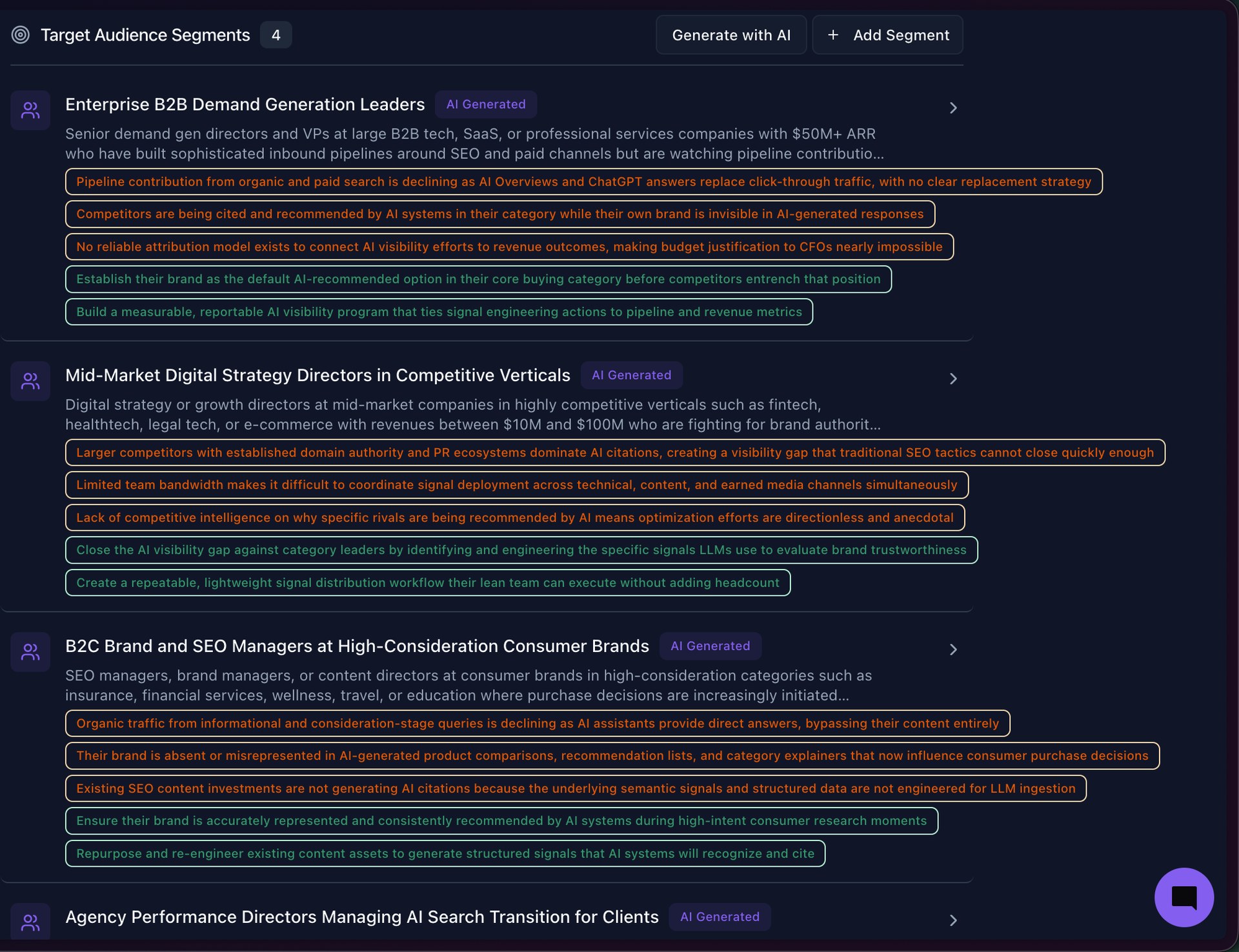
Products & Services → Persona → Target Audience Segments
Three modules carry out Step 1 in a few minutes. The system reads your site itself and pulls out the description of the company, products and services. From that same input it builds the market segmentation and the portraits of the people driving the deal — your job is to review and tweak. The output: a ready-made list of people and their questions you can take straight into Step 2.
02 · Step 2 of 9
Write 20 questions people ask AI
Outcome — A list of 20 questions, tagged by the buyer's awareness level. Every downstream measurement rests on it.
Why this step
Measure questions, not keywords: that's what people actually type into ChatGPT. If the list keeps changing, there's nothing to compare — every measurement starts from zero.
Those 20 questions split into three roles — each with a different meaning in sales. Market-shaping — the buyer isn't looking for a solution yet, they're just becoming aware of the problem ("why are our lawyers drowning in contracts", "how to speed up contract review"); you land in their head first. Demand-serving — the buyer is looking for a category of solution ("contract management software with Salesforce integration"); this is the bulk of traffic and the bulk of competition. Head-to-head — the buyer is comparing specific products ("Ironclad vs Icertis", "alternatives to Ironclad"); short path to a deal, but the AI answer is already crowded with competitors, so breaking in costs more.
The ratio between the three groups is a strategic choice. More market-shaping — a long game, you're creating future demand. More head-to-head — an attempt to peel buyers off specific brands right now. 20 is the ceiling you'll still maintain.
What to do
- 1.2–4 questions per person from Step 1. Phrase them chat-style, as full sentences.
- 2.Tag every question with its role: market-shaping / demand-serving / head-to-head. A reasonable starting mix — 6–7 of each; adjust later to fit your planning horizon.
- 3.No brand name in the question. Otherwise you measure reaction to your own name, not visibility.
- 4.Freeze the list and the date. Edit a question — log the new date; counting starts over from there.
Acceptance check
A reader who's never heard of your company can tell from the list: what business you're in, which problem you solve, who you compete with — and which of the three roles each question plays.
Example
Example · contract-management software
- · "best contract management software for mid-market legal teams" (compare)
- · "contract review tools that integrate with Salesforce" (picking between)
- · "alternatives to Ironclad for a 200-person company" (objection)
- · "how much does enterprise contract management cost per seat" (price)
How this looks in RankCaster
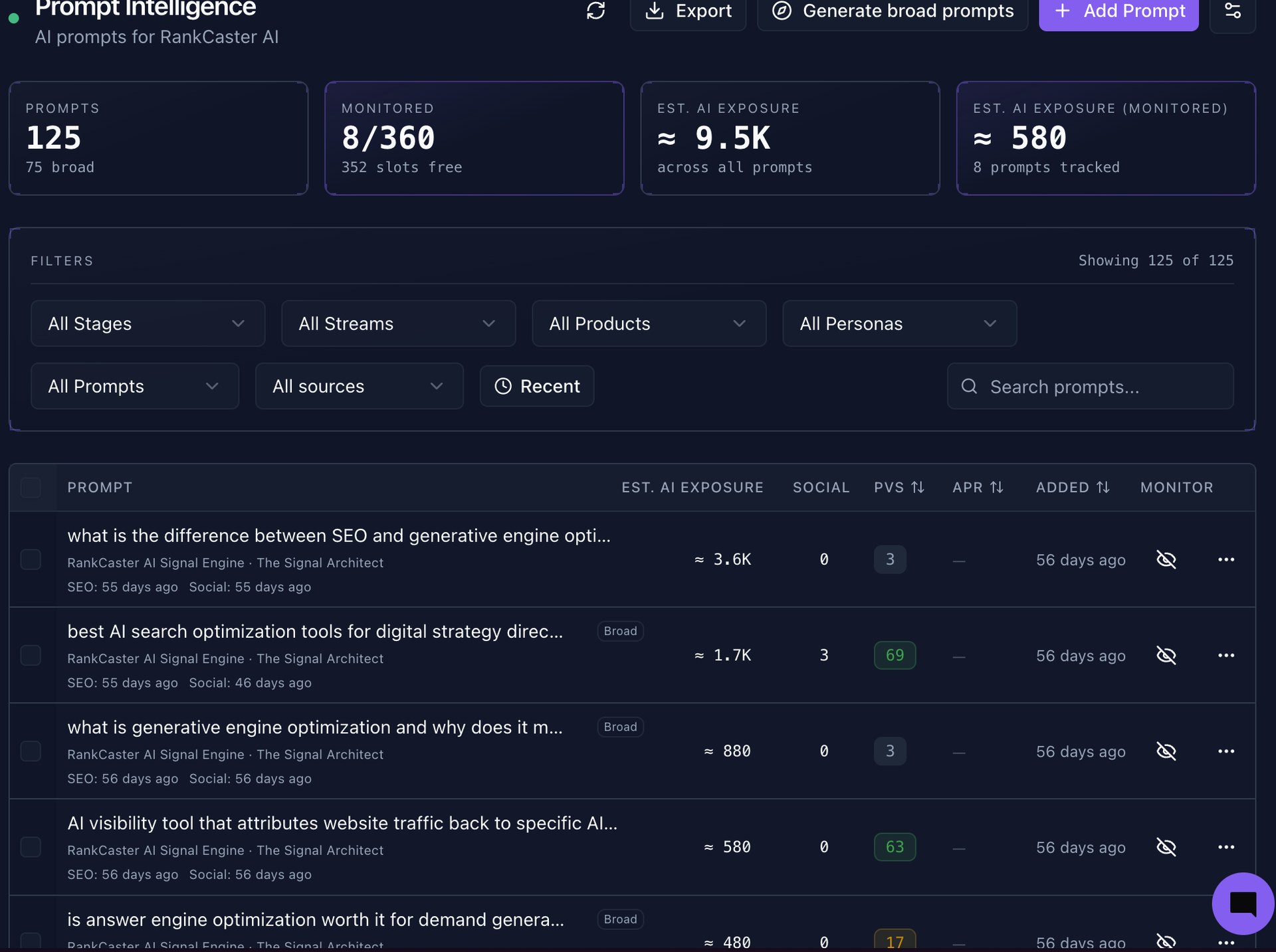
Prompt Intelligence
The section takes the people and their awareness levels from Step 1 and suggests the questions those people ask in AI — already sorted into the three roles: market-shaping, demand-serving, head-to-head. For every question you see the essentials: how often it's asked and how valuable it is for sales. Pick the 20 you need and send them to monitoring — minutes instead of hours of manual work.
03 · Step 3 of 9
Take the first measurement
Outcome — A table: for each question, how many times out of 10 AI named you and how many times it linked to your site. Separately for each model.
Why this step
AI answers the same question a bit differently every time. One run tells you nothing — ask the question 10 times in a row and see how many answers include you. That's the honest number.
Six models — six separate measurements. Each one has its own search engine under the hood (its own index, its own list of trusted sites), its own algorithm for picking and ranking sources, and its own internal memory from training. Whether to go to search at all or answer from memory is a call each model makes on its own, depending on the question. So for the same question ChatGPT, Perplexity, Gemini, Google AI Overviews, Claude and DeepSeek will return different answers with different brands inside — averaging them makes no sense, because they're running on different data and different rules.
Measure two things at once. First — were you mentioned in the answer (APR). Second — did your site appear in the source list (BSCR). Two different signals, two different situations: AI can praise you while citing someone else's blog, or cite you without naming you.
Also tag the context of each mention — plain mention, active recommendation, or comparative. Mention / recommendation / citation are three distinct outcomes. Collapse them into a single number and a rising "mention rate" can be hiding a drop in "recommendations" — your APR looks healthy while AI has quietly started suggesting someone else instead of you.
What to do
- 1.Ask each question in all 6 models in turn: ChatGPT, Claude, Perplexity, Gemini, DeepSeek, Google AI Overviews. Use default settings — the mode a normal user sees.
- 2.10 runs of the same question in a single day, same settings.
- 3.For each model record two numbers: in how many of 10 answers the brand was mentioned (APR), and in how many your site appeared in the sources (BSCR). If the model didn't return any sources — leave the second cell blank, don't fabricate.
Acceptance check
A table: rows are questions, columns are the 6 models, two numbers in each cell. 5–15% on commercial questions at the start is normal.
Example
Example of a single measurement row
| Question | ChatGPT | Claude | Perplexity |
|---|---|---|---|
| best contract management software | 1 of 10 | 0 of 10 | 3 of 10 |
Go deeper — our research
What the vendors themselves say
Official docs from ChatGPT, Claude, Perplexity, Google and Bing — the primary sources worth re-checking every time one of them changes policy.
- Claude Web Search tool — how Claude hits the web and returns citationsAnthropic Docs
- AI features and your website — what site owners see (AI Overviews, AI Mode)Google Search Central
- How web search works in Microsoft Copilot Chat and agentsMicrosoft Support
How this looks in RankCaster
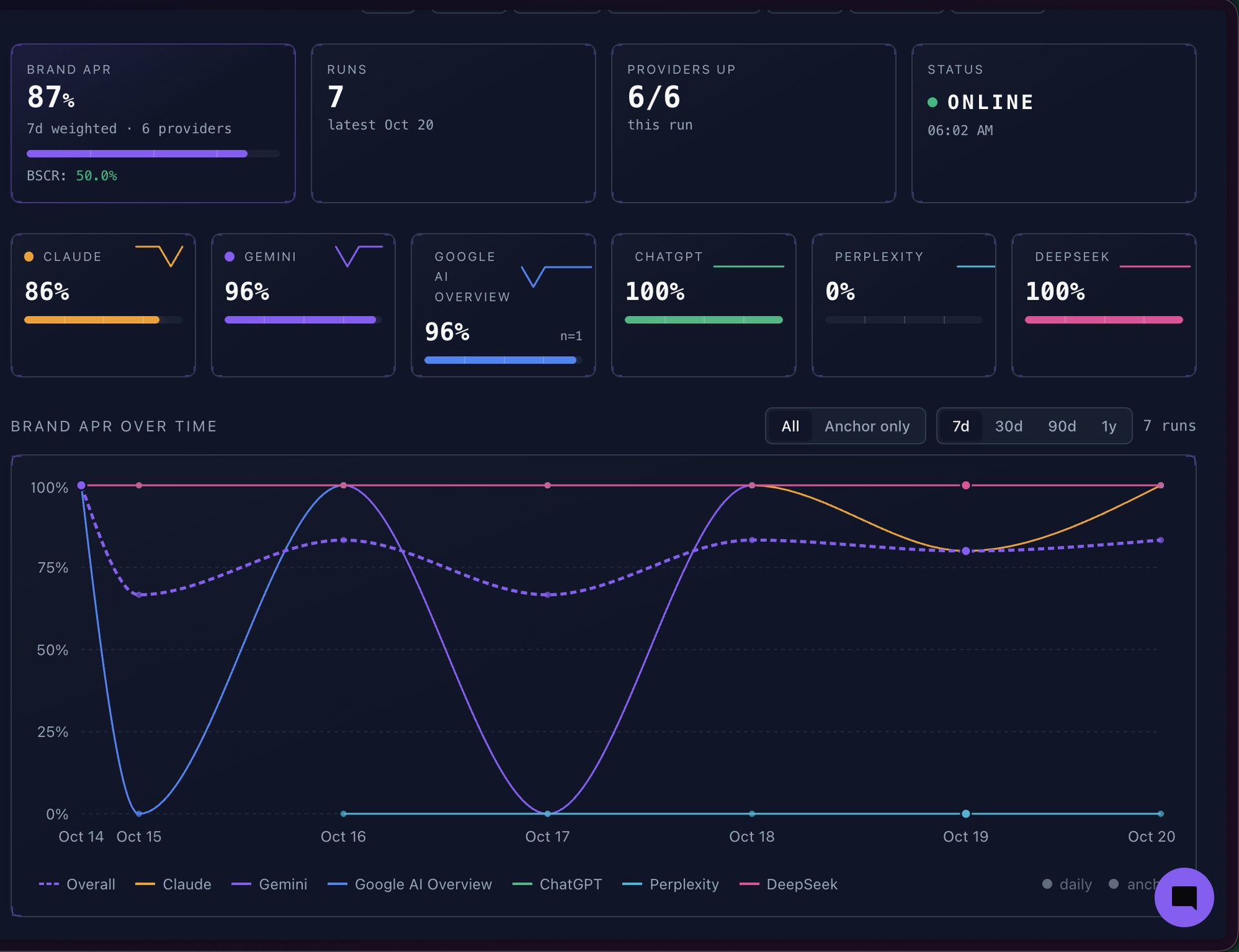
AI Visibility
The dashboard takes the measurement for you: runs every question through 6 models, repeats 10 times each, and shows the two numbers per question per model. Data refreshes daily — you can look at a week, month or year, see who AI cites instead of you, and which external surfaces are worth going after.
Don't want to measure by hand?
Run the auditThe free AI audit runs Steps 2–3 end-to-end in ~10 minutes: APR + BSCR on your prompts across 6 engines.
04 · Step 4 of 9
Make sure AI can actually see your site
Outcome — Your pages open for every major AI bot and return clean text.
Why this step
AI search has its own crawlers, separate from Google. If your site blocks them — accidentally or on purpose — not a word from your pages will reach ChatGPT, Claude or Perplexity. Google will keep seeing the site fine, and you'll never notice.
This is the first thing to check. Everything downstream is wasted work if AI can't read the page.
What to do
- 1.Open access to 6 AI bots in robots.txt: GPTBot (ChatGPT), ClaudeBot (Claude), PerplexityBot (Perplexity), Google-Extended (Gemini), CCBot, Bytespider.
- 2.Separately decide what to do with OpenAI's three bots — they do different things. OAI-SearchBot handles discovery for ChatGPT search and needs access. GPTBot governs potential use of your content for model training, which is a separate business decision. ChatGPT-User fetches a page when a specific user asks for it. Don't block them all with one reflex rule — decide what you're allowing and what you're not.
- 3.Put llms.txt on your site — a short summary of the company plus links to your main pages. No provider officially commits to reading it, but the file is cheap and useful as your own canonical set of facts (example below).
- 4.Key pages must show their text immediately, without JavaScript. Simple check: open "view source" in the browser and look for the content. Most AI bots don't run JS.
- 5.Serve the bot the same thing you serve a human. If you render a special "server version" for bots, verify the text matches the human version.
Acceptance check
Terminal command curl -A 'GPTBot/1.0' yourdomain.com/key-page returns 200 and the response contains the page's key text. Without this, everything downstream is wasted.
Example
Minimal llms.txt
# Example Co.
Contract-management software for mid-market legal teams.

## Primary pages
- https://example.com/product
- https://example.com/pricing
- https://example.com/customers

## Facts
- Founded: 2019
- Headquarters: Austin, TX
- Integrations: Salesforce, HubSpot, DocuSign
Go deeper — our research
What the vendors themselves say
Official docs from ChatGPT, Claude, Perplexity, Google and Bing — the primary sources worth re-checking every time one of them changes policy.
- Overview of OpenAI Crawlers — OAI-SearchBot (search), GPTBot (training), ChatGPT-User (user-triggered), OAI-AdsBotOpenAI Developers
- Does Anthropic crawl data from the web — ClaudeBot, Claude-User, Claude-SearchBot and robots.txtAnthropic Support
- Perplexity Crawlers — PerplexityBot (search) and Perplexity-User (user-triggered)Perplexity Docs
- Overview of Google crawlers and fetchers — Googlebot and other user-agentsGoogle Search Central
- List of Google's common crawlers — Google-Extended and GoogleOtherGoogle Search Central
- Which crawlers does Bing use (Bingbot — the path to Copilot)Bing Webmaster Help
How this looks in RankCaster
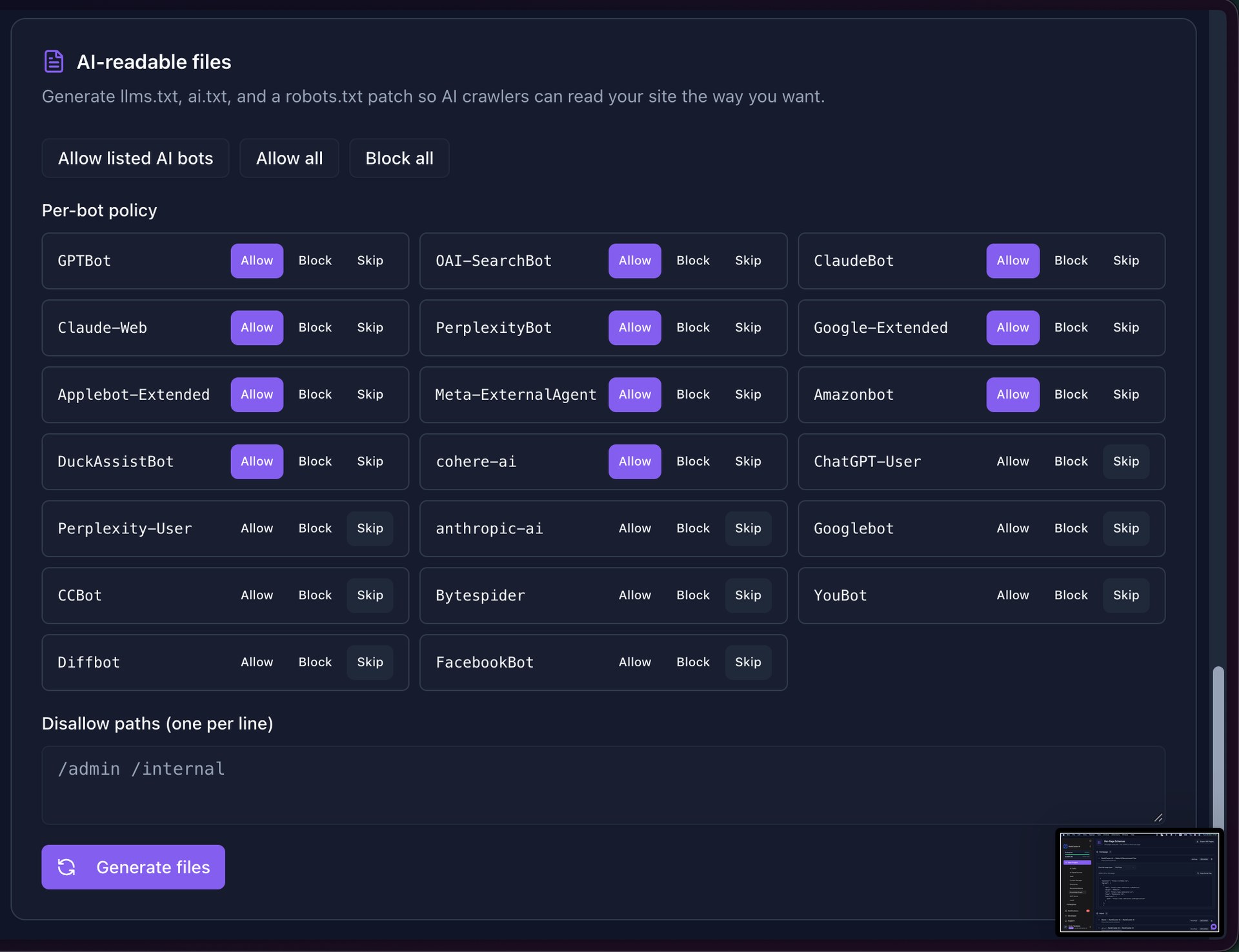
AI-readable files + Auditor (AIO, 105 rules)
The tool generates the right settings for all 20+ AI bots, assembles the AI-facing summary file for you, and gives you ready-to-paste text to drop onto the site. Separately it checks 105 technical conditions from Step 4 — does the site serve the bot without JavaScript, is anything accidentally blocked, is the bot being shown something different from the user.
05 · Step 5 of 9
Make it easy for AI to quote you
Outcome — Your main pages are written in short answer-shaped paragraphs and tagged with markup AI understands.
Why this step
AI quotes where the answer is already assembled. If the answer is scattered across four paragraphs, AI quotes the competitor who put it in one.
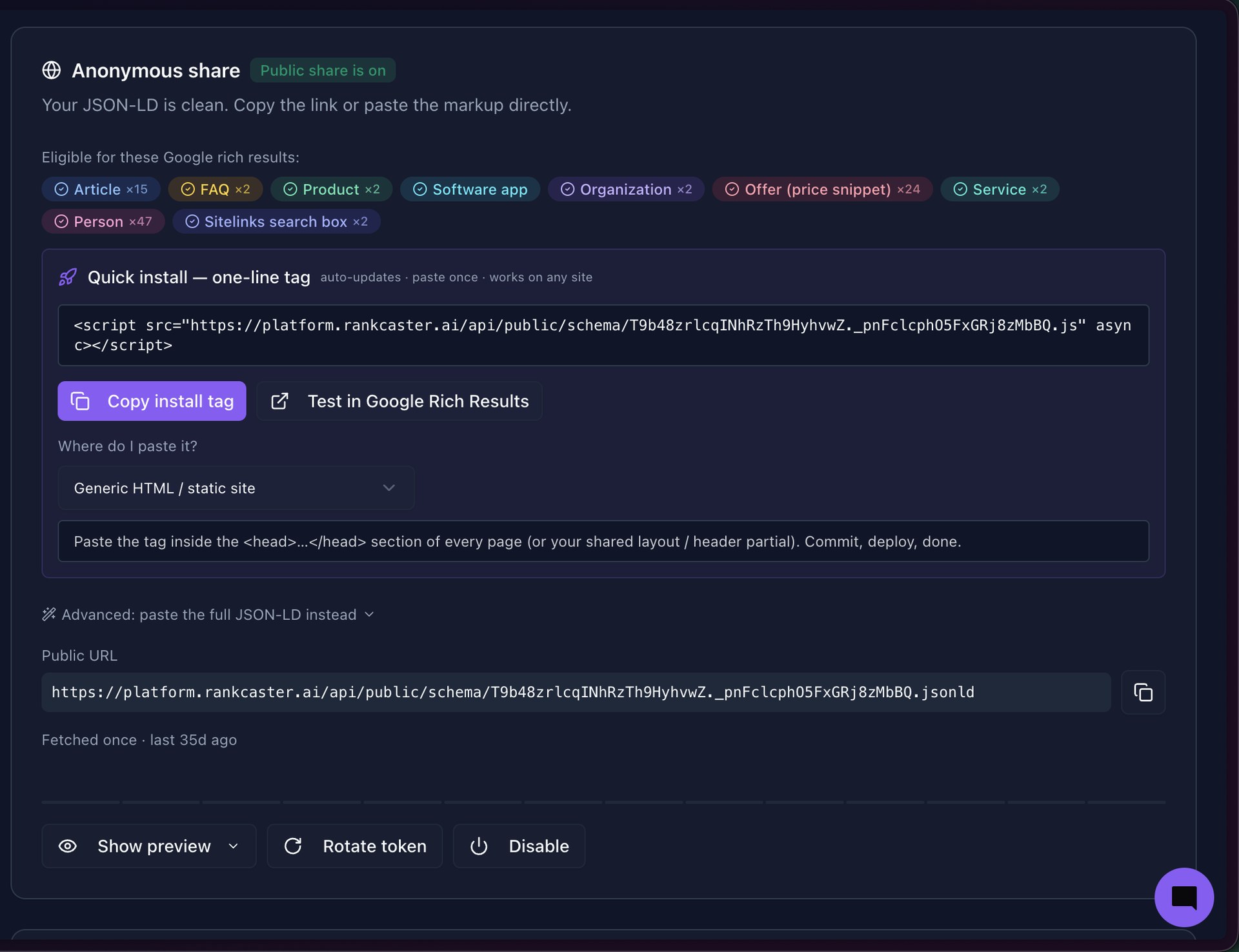
Markup (Schema.org) is invisible labels on the page telling AI what it's looking at — a product, an article, a company, a person. Without them AI guesses, and often guesses wrong.
What to do
- 1.Walk through your top pages: every paragraph should answer one question — standalone, without relying on the others. "The platform integrates with Salesforce via a native connector," not "We work with the leading CRM in a way that...". AI can drop a paragraph like that into an answer verbatim.
- 2.Add Schema.org markup — at minimum four types: company (Organization), product (Product), FAQ section (FAQPage), article (Article). Add Dataset and DefinedTerm if you publish research or a glossary.
- 3.In the company and article markup, fill the sameAs field — links to all your profiles: LinkedIn, X, Crunchbase, GitHub, Wikipedia, Wikidata (if you have an entry). That's how AI understands the company and the profiles are one thing.
- 4.Validate your markup: for Product, Article and FAQ — on search.google.com/test/rich-results. For Organization and Person — on validator.schema.org (Google has no checker for those types).
Acceptance check
Any paragraph from a page, pulled out of context, reads as a standalone answer to a question. Markup validation passes.
Example
Before → After rewrite
Before (not quotable)
"In the modern enterprise, teams struggle with disconnected tools, and that's where we come in — delivering value through our ecosystem of integrations."
After (quotable)
"Example CLM syncs contracts to Salesforce via a native connector, and routes approvals through Slack. Setup takes under 15 minutes for a 50-seat team."
Go deeper — our research
How this looks in RankCaster
Knowledge Graph · Schema.org + Rich Results
The tool assembles those "invisible labels" for AI across every page of your site — company, product, articles, authors, FAQ, prices. Paste one line into the site's head once, after that it updates automatically. Alongside it, Auditor checks 430 rules on the markup and 63 rules on the text itself from Steps 5–7.
06 · Step 6 of 9
Get into the model's "brain" — training datasets
Outcome — Your content lives inside the datasets that train the next versions of GPT, Claude and Gemini — so in 6–18 months the brand gets mentioned without any search at all.
Why this step
AI visibility has two channels, not one. The first is real-time retrieval (Steps 3–5): AI goes to your site right now, cites you, shows you in the answer. The second is parametric knowledge — your content ended up in the training dataset of a model, and the model mentions you from its internal memory, with no search at all. The first works in days; the second takes months, but that's the one that anchors the brand for the long run.
None of the major vendors (OpenAI, Anthropic, Google, Meta, Mistral) publicly discloses the exact composition of their training data — only the formula "public web + licensed sources + internal data". That means the only lever you have is the publicly documented datasets that either include your site or don't.
The cycle is long. Content that lands in Common Crawl today enters a monthly snapshot, then a cleaned derivative (C4, FineWeb) within weeks, then the next pretraining run of a given model — usually six months to a year out. Publishing today = mention in the model 6–18 months later. Slow, but worth it: once you're in, it works for years.
What to do
- 1.Allow training crawlers in robots.txt. Common Crawl (CCBot) is the main gateway: it feeds C4, FineWeb, RedPajama, Dolma, Pile-CC — the datasets most models train on. Also allow GPTBot (OpenAI training), ClaudeBot (Anthropic training), and remove any block on the Google-Extended token (controls use of your content in Gemini). Five lines of robots.txt — but without them this step doesn't work at all.
- 2.Publish on "white" platforms — the ones that are documented members of the training corpora of every open model. This isn't a marketing guess, it's a documented fact from The Pile, Dolma, RedPajama: Wikipedia (contribute edits, if the brand is notable), arXiv (preprint with research), a GitHub public repo under MIT/Apache (lands in The Stack v2), Stack Overflow (high-quality answers in your topic), HuggingFace Datasets Hub (publish an open dataset), Zenodo or Figshare (academic open data with a DOI).
- 3.Write like Wikipedia. The FineWeb-Edu classifier (one of the most widely-used quality filters in modern corpora) is literally trained to boost encyclopedic prose — neutral tone, facts + sources, definitions, structured H2/H3 headings. ACL 2026 showed that "Wikipedia-style reformatting" flips the classifier's decision on 7% of documents. For your flagship pages, this is a literal writing guide.
- 4.Permissive licence on part of your content. Dolma, Common Corpus, The Stack filter by licence — Creative Commons (CC-BY), MIT, Apache-2.0. If your research or glossary is published under CC-BY, it has a shot at entering open corpora, which in turn influence open-source models (Llama, Mistral, OLMo, Qwen).
- 5.Verify inclusion. Three free tools: index.commoncrawl.org (CDX query by domain — shows in which monthly snapshots CC has seen your URLs), wimbd.apps.allenai.org (search inside C4, Pile, RedPajama — shows exact presence of your site), and "Am I in The Stack" on HuggingFace for GitHub repos.
Acceptance check
Your domain shows up in a CDX query on index.commoncrawl.org for at least the last 3 monthly snapshots. At least one of the gateway platforms (Wikipedia, arXiv, GitHub, Stack Overflow, HuggingFace Datasets, Zenodo) hosts your content publicly.
Example
Example · minimal robots.txt for the training channel
# Common Crawl — the main gateway into C4, FineWeb, RedPajama, Dolma
User-agent: CCBot
Allow: /

# OpenAI — training for GPT (separate from OAI-SearchBot)
User-agent: GPTBot
Allow: /

# Anthropic — training for Claude
User-agent: ClaudeBot
Allow: /

# Google — token controlling Gemini training/grounding (not a separate bot)
User-agent: Google-Extended
Allow: /
This can be combined with another profile. For example: allow OAI-SearchBot so you stay visible in ChatGPT Search right now, but block GPTBot if you don't want training inclusion. Each vendor has three bots — training, search, user-triggered — tuned independently.
What the vendors themselves say
Official docs from ChatGPT, Claude, Perplexity, Google and Bing — the primary sources worth re-checking every time one of them changes policy.
- CCBot — Common Crawl, the gateway into C4, FineWeb, RedPajamaCommon Crawl
- GPTBot — OpenAI's training crawler (separate from OAI-SearchBot)OpenAI Developers
- ClaudeBot and Anthropic's web-crawling policy for trainingAnthropic Support
- Google-Extended — the token controlling training for Gemini and Vertex AIGoogle Search Central
- Common Crawl CDX index — check whether your domain is indexedCommon Crawl
- WIMBD — search C4, Pile, RedPajama by your domain (About)Allen AI
- The Pile — datasheet with the 22 documented sourcesEleutherAI / arXiv
- FineWeb — the dataset and edu-classifier that boosts encyclopedic proseHuggingFace
How this looks in RankCaster
Content Manager · AEO/GEO Auditor
There's no "training-corpus inclusion" tool anywhere — this is a long-term architectural channel, not a real-time metric. We have two indirect levers. Content Manager drafts articles in the neutral encyclopedic style — the one FineWeb-Edu's classifier boosts (facts + sources + structured headings, no marketing boilerplate). AEO/GEO Auditor checks, among its 598 rules, that your sameAs markup links to Wikipedia / Wikidata / arXiv / GitHub, and returns pages missing authoritative external links. We don't build a direct "inclusion tracker" because nobody can — the vendors don't disclose their corpora.
07 · Step 7 of 9
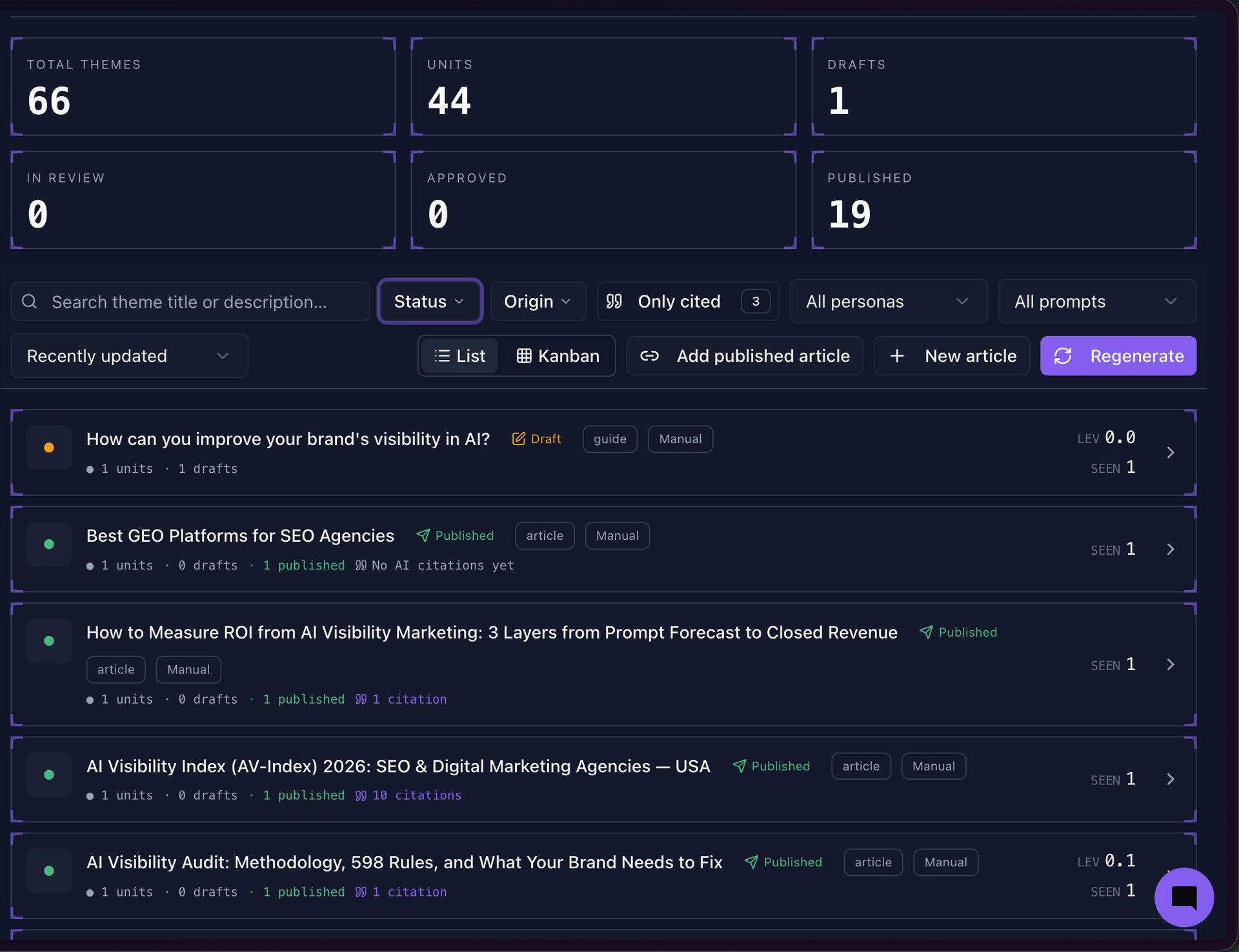
Publish 3–4 articles per month
Outcome — Per tracked prompt — one answer page on your domain.
Why this step
Until you have your own page for a question, AI has nothing to cite on your site. The only source of links is other people's publications, and the moment those go stale, you vanish.
On our dataset of 8,058 measurements: brands with their own articles for the questions reach 35% mention rate. Those with nothing published are stuck at 0.5%.
What to do
- 1.3–4 questions from the list per month. Start with "comparing" and "picking" — the buyer is closest to a deal there.
- 2.One article per question. Don't stuff three questions into one — AI won't know what to quote.
- 3.Put the question verbatim in the title and in the first paragraph (that will be the ready-made answer AI drops into the response). The heading on the page is shorter, written for a human.
- 4.From every article — links to product, pricing, customers pages. That's how AI understands the article is part of your site, not a text floating in isolation.
- 5.List an author: name, role, company, LinkedIn link. AI weighs who wrote it.
- 6.The first 1–2 weeks nothing moves in the measurements. Normal — AI re-learns the answer with a delay.
Acceptance check
For every question on your list there's one standalone page on your site with the question in the title and in the first paragraph.
Example
Case · education centre, Poland
First article shipped 26 August. In three weeks AI started citing the centre 65 times a week (was 13). The question "SMM courses in Europe" reached the point where AI named them in half the answers. The rule is simple: one article per question, publish regularly — in a month you have measurable visibility.
Go deeper — our research
How this looks in RankCaster
Content Manager
The tool suggests topics and writes articles for you — not just text, but in the shape AI is ready to drop into an answer. Before publishing, every article passes an AI-fitness check: one paragraph = one answer, concise, with markup, direct facts, matching the question from Step 2. One-click publishing to all your own channels — your blog, LinkedIn, Medium, Dev.to, Reddit, corporate properties — you connect each one through an integration once, after that a single click publishes everywhere at once, with automatic repost to social.
08 · Step 8 of 9
Get other people to write about you
Outcome — For every question — 2–3 external pages that mention your brand.
Why this step
AI doesn't like citing only the site itself — it wants outside confirmation. On our dataset: brands mentioned only by their own pages reach 35% in answers. Brands cited by 2–3 independent sources reach 58%.
Surfaces aren't equal. AI happily cites LinkedIn articles — that's your main external channel. Industry directories like G2, Clutch, SourceForge give 1–9 mentions each, but they cover niche topics LinkedIn doesn't.
What to do
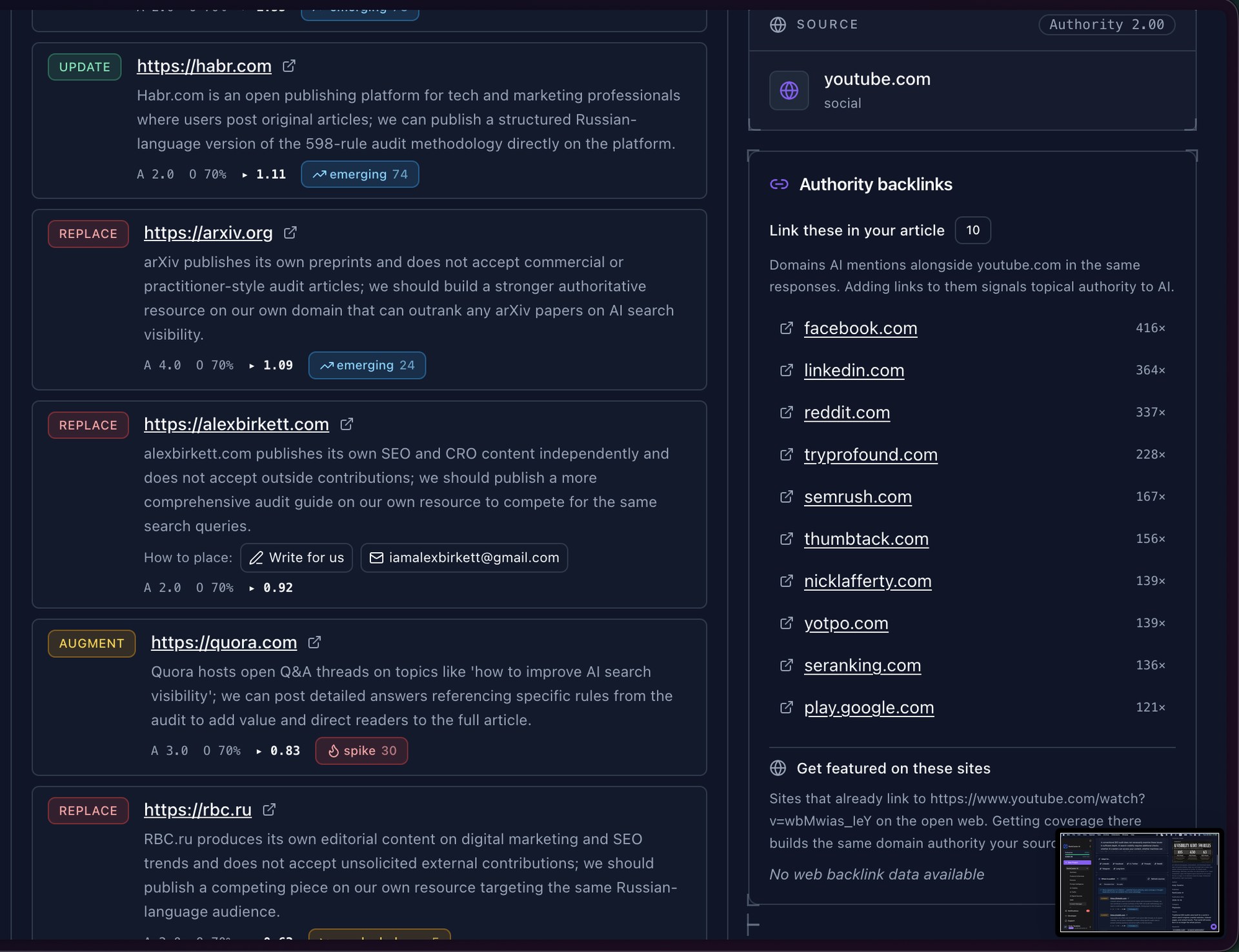
- 1.For every article from Step 7 pick 2–3 external surfaces where your direct competitors are already cited. In RankCaster this list is assembled automatically inside Content Manager → Where to publish — the platform ranks them by who's realistically willing to accept your pitch.
- 2.Register on the industry directories and review sites AI actually cites (G2, Clutch, SourceForge, Capterra, etc.) — fill the profile completely; an empty or half-empty profile is worse than none, AI treats it as an unreliable source. The shortlist tailored to you is in the Directories section.
- 3.On social (LinkedIn, Reddit, X) publish one post per article on your site, with a link to the original. That's enough — if you do it consistently.
- 4.If you run several brands — have them mention each other. Cross-mentions between two brands in our study delivered 664–698 mentions each.
- 5.Don't waste time on surfaces where AI cites nobody. Easy to check: ask ChatGPT about a competitor — if the surface isn't in the sources, skip it.
- 6.What not to do. Don't buy bulk reviews on G2 / Capterra and don't farm fake endorsements — AI engines are reasonably good at spotting those patterns, and the fallout for your domain is permanent. Don't spin up dozens of boilerplate "you vs competitor N" pages without a real comparison — URLs go up, trust and citations don't.
Acceptance check
For every question on your list you can name 2–3 external pages that mention your brand, each opening in a browser without login.
Example
Example · one article's path out into the external web
Your article "Ironclad vs Icertis vs Agiloft for mid-market SaaS" shipped on your blog. Three external touchpoints for it:
- 1 · G2 — your profile in the Contract Management category with 10+ full reviews. ChatGPT and Perplexity cite G2 in most product-comparison prompts.
- 2 · LinkedIn Pulse — a post from the General Counsel (one of the people from Step 1) linking back to your article. AI picks up public LinkedIn posts as a source.
- 3 · Reddit r/legaltech — a comment under an existing "which CLM for mid-market?" thread, pointing to your article as the deep-dive. AI often quotes Reddit answers.
Three different source types (directory / social network / forum). The same route repeats for every article from Step 7.
Go deeper — our research
How this looks in RankCaster
Where to publish · Directories · SMM
Three connected tools for this step. Where to publish inside Content Manager — for every one of your articles the platform picks external surfaces where your topic is already cited, ranks them by who's realistically willing to accept your pitch, and shows the concrete route: email the editor, pitch a case study, run a guest post. Every surface has a tracker (pitch sent → accepted → published), and once something's published the platform measures whether AI citation actually went up. Directories — a separate section for catalogs and review sites (G2, Clutch, Capterra, SourceForge): the platform finds the ones AI actually cites for your prompts, marks whether you're registered, shows the type (free / paid / invite-only) and the link to your listing. SMM — a separate section for social media: finds every discussion in Reddit, LinkedIn, X, YouTube and others where AI shows your brand or competitors, generates a reply in your voice in one click and publishes it — Reddit and LinkedIn through connected accounts, the rest copied as a draft.
09 · Step 9 of 9
See the real results
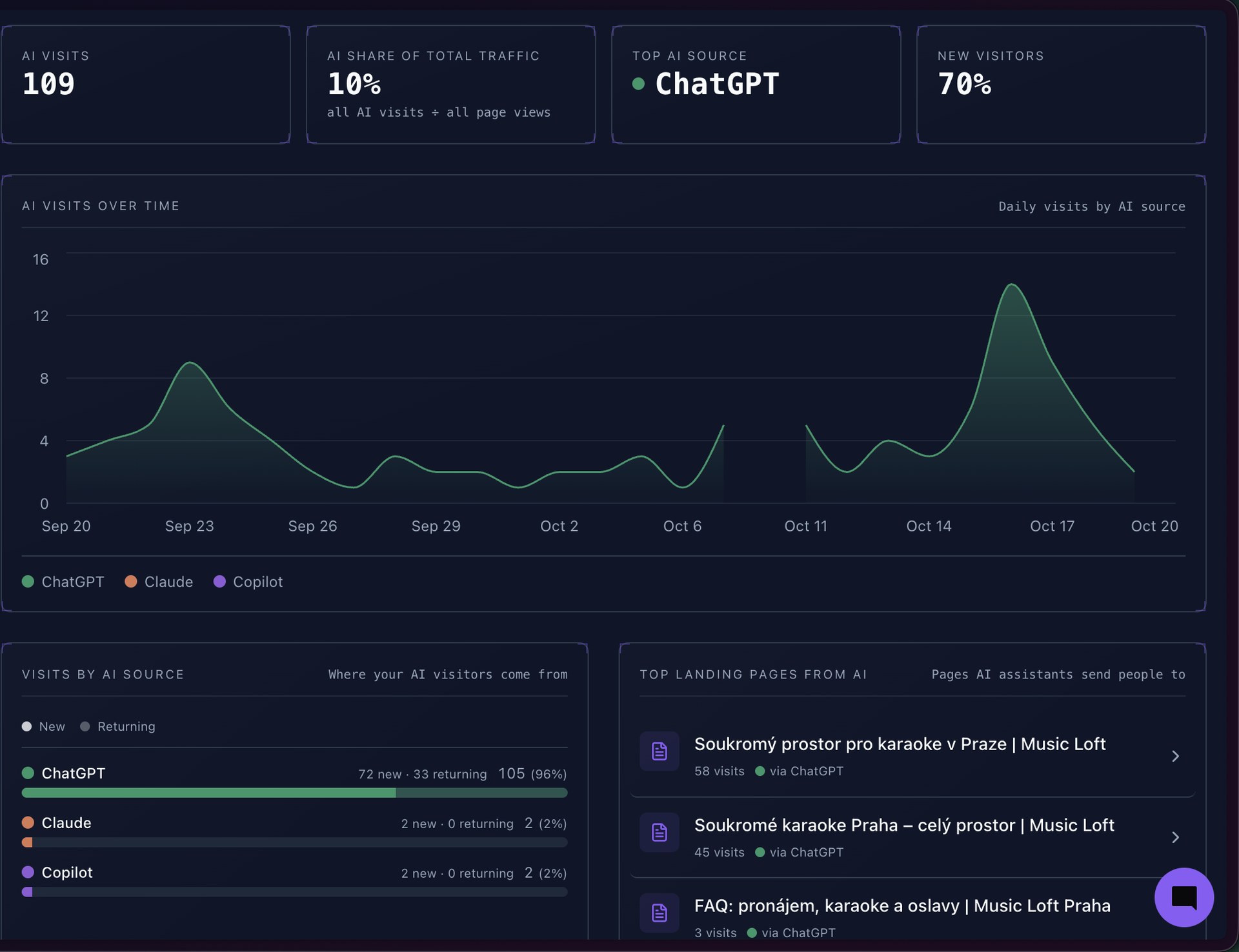
Outcome — By the end of the quarter you see not just where AI started naming you, but how many real people arrived from AI tools, and how that fed into the rest of your traffic, leads and sales.
Why this step
AI changes not only where you're seen, but the whole buyer path. They read about you in ChatGPT, a week later they search by name, a month later they come to the site directly. If you only watch direct AI traffic, you'll miss most of the result — it'll show up as "organic" and "direct" in your regular analytics.
That's why you measure the result in several layers at once: what changed in the AI answer itself (APR and BSCR), how many real people arrived from AI tools (your site tags that traffic separately), how it rippled through the rest of your traffic sources and, most importantly, through actual deals.
Be careful with the numbers. If your baseline APR is near zero, don't report relative percentage gains ("we went from 1% to 3% — that's a 200% lift"); report percentage points (that's +2 pp). Relative growth only makes sense off a non-zero base, otherwise "APR tripled" stops meaning anything.
What to do
- 1.Repeat the Step 3 measurement — weekly or monthly. On your top 5 target questions +20 points over a quarter means the programme works. No movement on any of them — go back to Step 4 and Step 7; something in the technical layer or the content is falling off.
- 2.Put the RankCaster pixel on your site. It tags visitors arriving directly from ChatGPT, Claude, Perplexity, Gemini, Copilot and Google AI Overviews — instead of an "unknown referrer" column you see live people from a specific AI tool.
- 3.In parallel watch your regular analytics (Google Analytics, Plausible, whatever you use). Over 2–3 months you'll see growth in three places at once: Google organic (your Step 7 articles rank there too), branded search (people read about you in AI and search by name), direct traffic (same reason).
- 4.Qualitative signals your sales team will notice: customers arrive better prepared — they already know what you do, don't ask basic questions; the deal cycle shortens; trial-to-paid conversion goes up. This isn't on a dashboard, it's in team conversations.
- 5.Add a question to your customer onboarding: "how did you hear about us" with concrete options — ChatGPT, Claude, Perplexity, Gemini, Copilot, Google AI Overviews. Over 2–3 months AI sources will take a visible share of the answers that wasn't there before.
- 6.Keep a control group of questions. Pick 3–5 prompts you deliberately do NOT reinforce with new content or external mentions, and measure them with the same methodology. If APR on your target questions grows while the control group holds steady, that's the effect of your programme — not a general AI-traffic rise across the industry. Without a control group, you can't tell them apart.
Acceptance check
By day 90 you can show five things on one page: APR and BSCR trend across the quarter, traffic from AI via the pixel, growth in organic and branded search in your regular analytics, trial conversion dynamics, and the AI share in the "how did you hear" survey.
Example
What you'll see by the end of the quarter
- · APR and BSCR on target questions grew from single-digit percentages to around half — AI names you in most answers.
- · AI Traffic shows real visitors from ChatGPT, Perplexity, Claude — where before there was an empty "unknown referrer" bucket.
- · Google organic grows alongside — your articles rank there too. Branded search grows — people read about you in AI and come by name.
- · Sales team notices that customers arrive better prepared: they know what you do, ask about pricing and integrations rather than the basics.
- · Onboarding survey: a visible share of new customers names ChatGPT or Perplexity as the first source — a bucket that didn't exist in the survey before.
Concrete numbers depend on your niche, deal cycle and the pace at Steps 7–8. For B2B SaaS with a 1–3 month cycle and 3–4 articles a month, the growth is visible by the end of the second month.
Go deeper — our research
How this looks in RankCaster
AI Visibility · AI Traffic · Dashboard
Three connected screens close Step 9. AI Visibility shows APR and BSCR trends over 7, 30, 90 days or a year — you see when and which metric dropped, and can drill into every question separately. AI Traffic — you put a single pixel snippet on the site (copied from the UI, one line into <head>), and the platform starts tagging visitors who arrived from ChatGPT, Claude, Perplexity, Gemini, Copilot and Google AI Overviews; a separate AI Bots section shows which AI crawlers are hitting your pages. The main Dashboard pulls it all into one funnel: how often AI answers your questions in a month → in how many of those you were mentioned → how many real visitors that brought you.
After Step 9 · the operating cadence
How you keep the gains — the weekly loop
Steps 1–9 get you to the 50–60% band on your tracked prompts. Keeping it there is a different discipline: three things to do every week, every month, forever.
Get every important question past 6 mentions a week
On our dataset, that's the tipping point. If AI mentions you 0 times a week for a question, you appear in half a percent of answers. 1–5 times — in 21%. 6+ times — in half. The gap between "1–5" and "6+" is almost 30 points, the biggest in the whole measurement. First push your top 5 questions past 6 a week, then take on the rest.
Re-measure weekly and see what dropped
Repeat the Step 3 measurement every week. Watch which of the two numbers fell first. If mention rate (APR) dropped and sources (BSCR) are intact — a competitor started publishing and beat you in the answer (fix: write on the same topic, better). If sources dropped — your pages stopped being treated as reliable (fix: back to Step 4 — is something blocking the bot, is content fresh, is markup in place).
Protect the pages that work
We tracked 5.22 million mentions over a year. 3% of pages AI cites steadily for 4+ months. The rest either flash and fade in 2–3 weeks, or slowly decline over a couple of months. How to spot the long-lived page: if 4 out of 6 models are citing it two weeks after publication — it's an asset, update it, expand it, promote it. If only one — it's a one-time flash, don't invest.
How it works in RankCaster
Recommendations · Action Plan
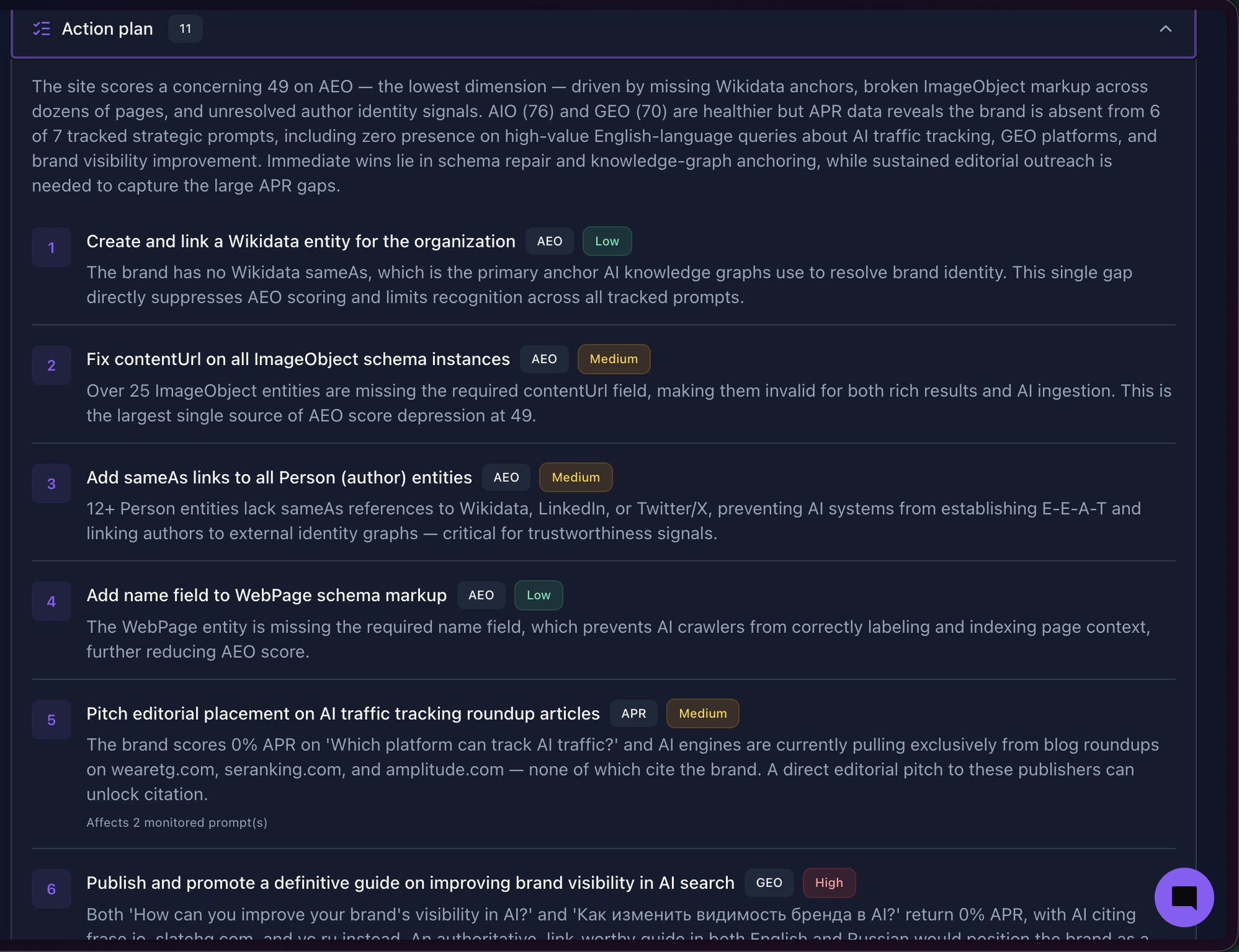
Every week the platform re-runs the full audit of your site, recomputes the four scores (Overall / AIO / GEO / AEO) and assembles a prioritised action plan — concrete tasks tagged by category (AEO / GEO / APR) and priority. For each one — an explanation of what's broken, which score it's dragging down, and why it matters. You pick the top 2–3 tasks, ship them in a week — the next audit shows which scores moved up. That's your working cadence, with no debate about what to do next.
Timeline · at 3–4 articles per month
What to expect, week by week
Projected forward from the same 8,058-observation study at the recommended cadence. These are observed anchors across four live brands, not marketing promises. Share this table with whoever asked "when will this work?" before you start.
| Phase | Published volume | What to expect |
|---|---|---|
| Weeks 1–2 | Measurement + 2 articles | Nothing moves in the measurements — AI re-learns the answer with a delay. |
| Weeks 3–4 | 3–4 articles | AI starts citing 5–20 times a week; on your 2–3 strongest questions — mentions in 20–50% of answers. |
| Month 2 | 5–8 articles | 15–40 mentions a week; on questions you work actively — 40–55% of answers carry your brand. |
| Month 3 | 9–12 articles | 25–60 mentions a week; half the answers to target questions include you. |
Troubleshooting
What to do when AI stops mentioning you
Four reasons this usually happens. Each has its own treatment. Misdiagnose the cause and you'll cure the wrong illness.
Reason 1 · Competitor
You were in every answer — in 6 weeks it dropped to 4 out of 10. Mentions on other sites didn't change.
What to do: see who's new in the AI answer set. Read what they published. Update your article with fresher facts, numbers, cases. Add one new external mention.
Reason 2 · Paused
A topic reached 100% mentions in AI — and went to 0 the moment you stopped shipping on it.
What to do: visibility is a flow, not a stock. Old publications don't hold anything on their own. Return to the Step 7 cadence on this topic: a new article and a new external mention.
Reason 3 · Flash
One in five pages flashes brightly in the first week and stops being cited by the third month.
What to do: check how many models cite the page two weeks after publication. One — it's a flash, line up a replacement. Four or more — the page is an asset, protect it (update, expand, promote).
Reason 4 · Access broken
A robots.txt edit accidentally blocked one of the AI bots — Google Search Console won't tell you.
What to do: back to Step 4 and verify all 6 bots return 200. This is the sneakiest break — invisible on normal SEO dashboards.
One-page checklist · the whole playbook in 13 lines
Print this and work through it in order
- Step 1 — the buying company and 2–4 people inside who drive the deal.
- Step 2 — 20 questions those people ask in AI, no brand name in the wording.
- Step 3 — for every question, 10 runs across 6 models: were you mentioned (APR) and did your site land in the sources (BSCR).
- Step 4 — access for 6 AI bots in robots.txt, llms.txt on the site, pages serve text without JS, bot and human see the same thing.
- Step 5 — main pages carry Schema.org markup (Organization, Product, FAQPage, Article), with sameAs listing all company profiles.
- Step 5 — every paragraph on the top page answers one question on its own.
- Step 6 — robots.txt allows CCBot, GPTBot, ClaudeBot and Google-Extended; at least one gateway-platform publication (Wikipedia, arXiv, GitHub, Stack Overflow, HuggingFace, Zenodo).
- Step 7 — 3–4 articles per month, one article = one question from the list.
- Step 8 — per question, 2–3 external mentions on surfaces AI already cites.
- Step 9 — re-measurement of APR and BSCR, the AI Traffic pixel on the site, a fresh organic / branded / direct cut in your regular analytics, and a "how did you hear" question in customer onboarding.
- Weekly — push every important question past 6 mentions a week. Depth first, then new questions.
- Weekly — re-measure and diagnose by the four reasons in troubleshooting.
- Weekly — check each page: 1 model cites it — a flash, 4+ — your asset.
- Monthly — full Step 3 measurement to answer "is the whole programme working".
Frequently asked questions
What's the difference between APR and BSCR?
APR is "you were mentioned in the answer". BSCR is "your site landed in the sources". Two different signals. If AI praises you while citing an article on G2 — you have high APR and low BSCR. The day that G2 article is rewritten, you vanish from the answer. So measure both: when something drops, the difference between the two numbers tells you exactly where it broke.
Do I need a platform to work through this guide?
No, every step can be done by hand. The platform just speeds up the three most time-consuming parts: assembling buyer portraits (Step 1), running measurements across 6 models (Step 3), and checking your site's technical fitness for AI search (Step 4). The free audit does that in about 10 minutes.
When will I see the first result?
At a cadence of 3 articles a month, visible movement arrives by week 4; by the end of month 2, AI mentions you in 40–55% of answers to target questions; by month 3 — in 50–60%, if external work from Step 8 is running in parallel. Real case from our measurement: a US contractor-matching platform lifted mentions from 6.3% to 14.4% in 6 weeks.
How many AI models should I track?
A minimum of two from different families (ChatGPT and Gemini will do). But pages cited by all 6 models at once live 2–3× longer than pages cited by one. So if resources allow — measure all six; it also tells you which pages are becoming long-term assets.
Can I skip Step 7 or Step 8?
You can, but you'll hit a ceiling. Own articles only — up to 35% mentions. External only — up to 40%. Together — 58%. They're not alternatives; they're two parts of the same machine.
What does getting into the training dataset (Step 6) give you, and when does it pay back?
Step 6 is the long-horizon channel: your content lands in the training corpus (Common Crawl → C4/FineWeb → the next pretraining run), and the next versions of GPT, Claude and Gemini mention you from their internal memory, without any search. The cycle is long — 6–18 months from publishing to appearing in the model. It's not a replacement for retrieval (Steps 3–5 move the needle in days); it's a parallel channel that anchors the brand for years. Minimum entry: allow CCBot, GPTBot, ClaudeBot and Google-Extended in robots.txt + one publication on a gateway platform (Wikipedia, arXiv, GitHub, Stack Overflow, HuggingFace, Zenodo).
Why can a #1 Google page not be cited by AI?
The overlap between the Google top 10 and sources AI cites is around 3%. AI likes short paragraphs with a direct answer, Reddit and YouTube discussions, Schema.org markup. A long "SEO-optimised" page with the answer smeared across paragraphs ranks in Google but doesn't make it into ChatGPT. Fix with Step 5.
How is this different from regular SEO?
Different thing to measure (mention in an AI answer vs position in Google), different signals (markup and mentions on external sites vs links and keywords), different content shape (short answer paragraphs vs long keyword pages), and repeated measurements instead of a one-time check — because AI answers slightly differently every time.
What does RankCaster do that Ahrefs or Semrush don't?
Classic SEO tools measure Google positions and backlinks. RankCaster starts with who you sell to and who in that company asks questions in AI (Step 1), measures mentions and sources for your questions across 6 models at once (Step 3), assembles the markup and profiles AI needs (Step 5), and shows which AI tools sent visitors to your site.
Run the baseline and the 598-rule audit on your own site
Free, no signup until the report is ready. Returns per-prompt APR across the engines, the prioritised AIO/AEO/GEO fix list, and the destination gaps you'll fill in Steps 5–8.
Ready to run this ongoing — see pricing or the GEO platform comparison.
Sources: the 598-rule methodology, the seven-tactic playbook and the 8,058-observation study. Numbers quoted on this page come from one of them.